

Introduction
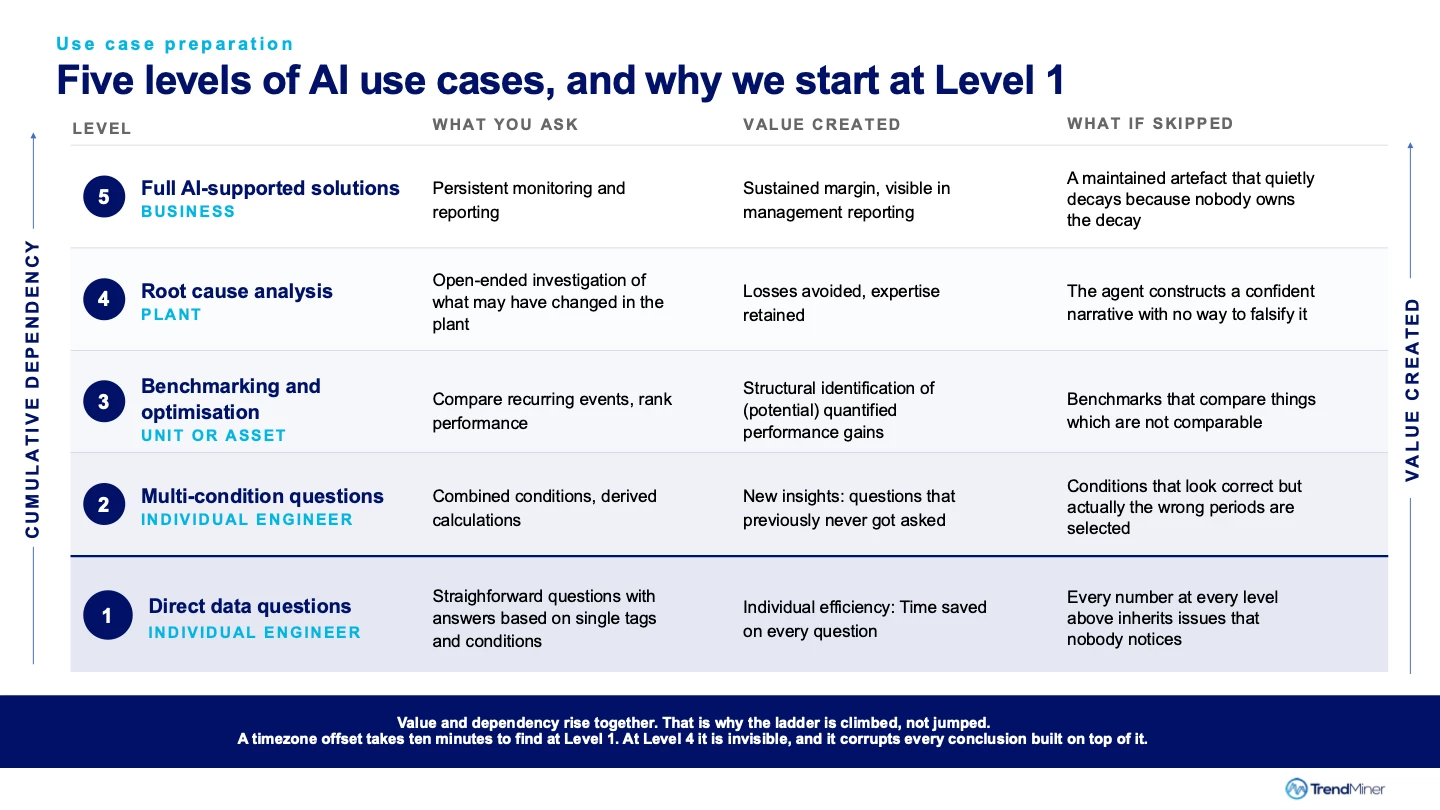
We have shown this use case framework a few times now, as a useful way to get people thinking about their own use cases and structure their AI projects. Due to popular demand, I’m sharing it more widely here on our Community as well so all our customers can potentially benefit.
The idea behind the framework is relatively easy: start small, experience success, and build from there.
Why trust matters
The question it always provokes is the obvious one. Level 5 holds great promise: standardised, corporate, enterprise-scale value, visible all the way up to management reporting. So why not start there?
Because the steps in between deliver value too, and skipping them means skipping what makes the higher level use cases sustainable. Each level earns its own return, and along the way it builds the trust, momentum, and muscle memory you need to climb higher.
Let’s start with trust.Trust comes by foot and leaves by horse. It builds slowly, question by question, and it collapses the moment the Agent confidently gives you an answer that turns out to be incorrect.
This is exactly what Level 1 protects against. At Level 1, you ask straightforward questions, often ones you already know the answer to. If a timezone configuration is wrong, a tag is mapped incorrectly, or a unit of measure is off, you will find it in a couple of minutes. Small misconfigurations are cheap to spot and fix at this level. The same issues at Level 4 are invisible, and will silently corrupt every conclusion built on top of it. Value, complexity, and dependency rise together, which is why the ladder is climbed, not jumped.
Climbing it also teaches you something you cannot appreciate from the top: how much context matters. As you move from single-tag questions to multi-condition logic, to benchmarking across assets and open-ended root cause analyses, you start to see why asset structures and proper context are not optional extras. They are what make the higher levels trustworthy. You build that understanding, and can build these structures, along the way. Each time seeing immediate benefit of that additional work paid back, reinforcing the loop.
This is also why the framework is useful well beyond the first conversations. Treat it as a way to develop your use cases and to document the value created at each step. Even if you are just getting started, each level gives you a concrete place to capture what you asked, what it was worth, and what you built to sustain the value going forward. By the time you reach the top, you will have the results, the value, and the evidence of how you got there.
Conclusion
Start at level 5 and you jump straight into the deep end with nothing to keep you afloat when things go wrong. Start at Level 1 and climb your way up, with the value, trust and context earned along the way.
I’m curious to hear from you where you would place yourself on the latter today, and what the first surprising answer was that showed the value of this approach!