



SABIC is one of the world’s largest chemical companies. It celebrates its 50th anniversary this year and has grown to around 26,000 employees and about 60 manufacturing and compounding sites.
At TrendLab 2026, Maurice and Christoph from SABIC shared their approach to smart plant monitoring. Their general message was technology alone is not enough. Successful monitoring needs people who understand its value and are properly trained, a clear process with an owner for every monitor, and the right platform for data integration, analytics and visualization. That’s why SABIC chose TrendMiner.
Use case 1: Evaluating new technology in the cracker
The coils in SABIC’s cracker furnaces slowly build up coke on the inside, which raises their temperature until they must be cleaned. SABIC wanted to know whether a new technology really reduced this buildup. Using TrendMiner, the team identified every operating run, built fingerprints of the runs before and after the change, and compared them. The evaluation was faster, more reliable and easier to visualize than with standard methods, and it now runs as a monitor that tracks whether the new coils keep performing over time.
Use case 2: Early warning on a reactor bearing
A large reactor agitator runs on a heavy bearing that slowly wears, and a failure can cause an unplanned shutdown. A single temperature signal was too unstable to rely on. In TrendMiner, SABIC built a multivariate regression model that predicts the expected bearing temperature and compares it with the actual value in real time. A deviation of more than two degrees signals a problem.
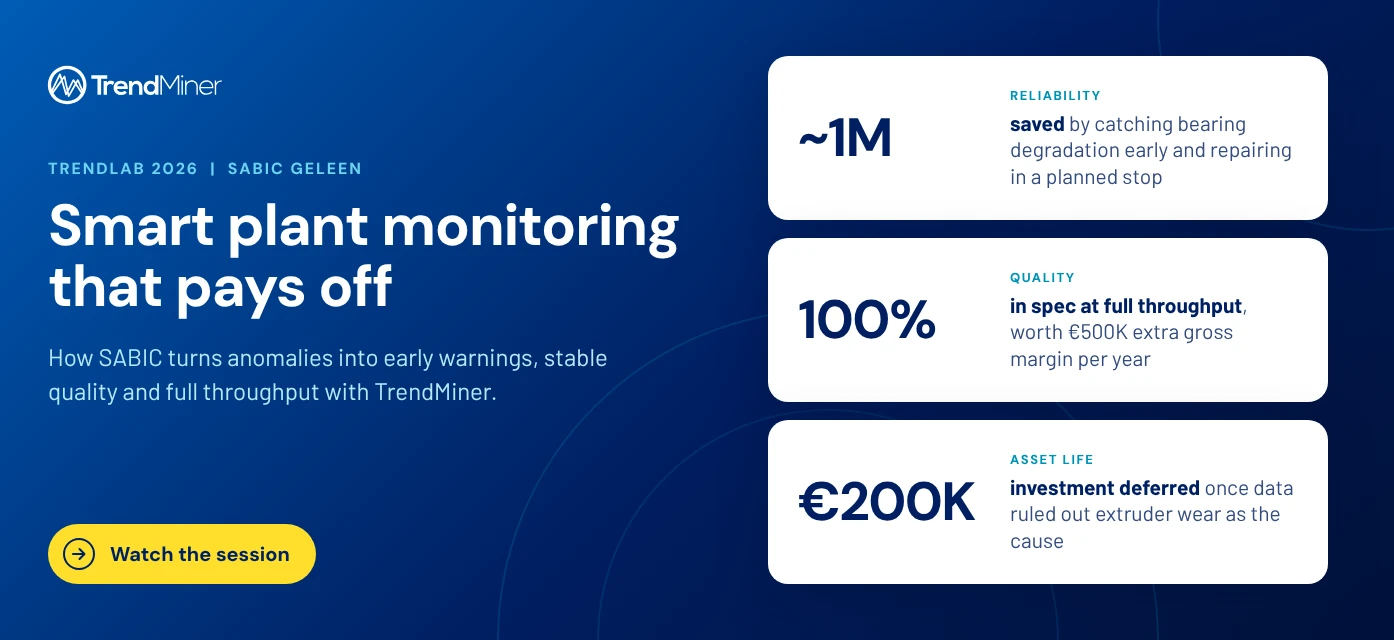
- The monitor detected the degradation early, so the repair moved from a major turnaround later in the year to a smaller, earlier stop.
- Inspection after the repair confirmed the bearing was degraded and would not have lasted until the planned turnaround.
- Savings: about 1 million Euros.
- The model has already been scaled to four machines.
Use case 3: Stable quality on a polymer grade
One polymer grade kept going off spec without a clear reason, which forced SABIC to reduce capacity. Even with limited and imperfect data, the team built a model of eight controllable parameters that predicts quality. It revealed the sweet spot and led to a new, more precise recipe.
- 100% in spec at full throughput.
- €500,000 extra gross margin per year.
- The data showed the issue was not caused by extruder wear, deferring a €200,000 investment in new screws.