












Discover our learning resources and share your experiences...
Recently active
The picture shows a change agent offering a more efficient way of getting things done. Unfortunately, there are blockers that hold back people from changing their ways. What we see here did not only happen in the stone ages. It’s something very natural as our brains enjoy the comfort of the known and often try to reject the new. BUT there are actions to take to help people manage change. Let’s look at some blockers and how to deal with them below. People stick to doing what they know: this is the way it’s done for a longer period & it gets the job done The longer people do things in the same way, the more difficult it is to introduce changes. The best course of action is to know the benefits of the change and sharing them often on multiple levels (see point 2). Pro tip 1: Have 1-1 conversations with the most outspoken people showing resistance to understand concerns and help address them. People who resist the most can be your greatest advocates Pro tip 2: it makes a lot of sense
TrendMiner’s mission is to design and deliver a fast, powerful, and intuitive platform that drives the adoption of data and analytics for everyone in industrial operations to make smarter data-driven decisions. To deliver on the mission and democratise data analytics in your company, change management ensures that new processes, technologies or organisational changes, such as the introduction of TrendMiner, are implemented smoothly and successfully in order to minimise resistance and maximise commitment and acceptance. By managing the human side of change, project managers and coaches can facilitate a smooth transition, encourage employee engagement and drive continuous improvement, with the TrendMiner team supporting you throughout the journey. TrendMiner’s 8 Change Management Best Practices Engage Stakeholders Early and Often: Involve stakeholders from across the organization in the adoption process from the beginning. Seek input, address concerns, and ensure that all voices are he
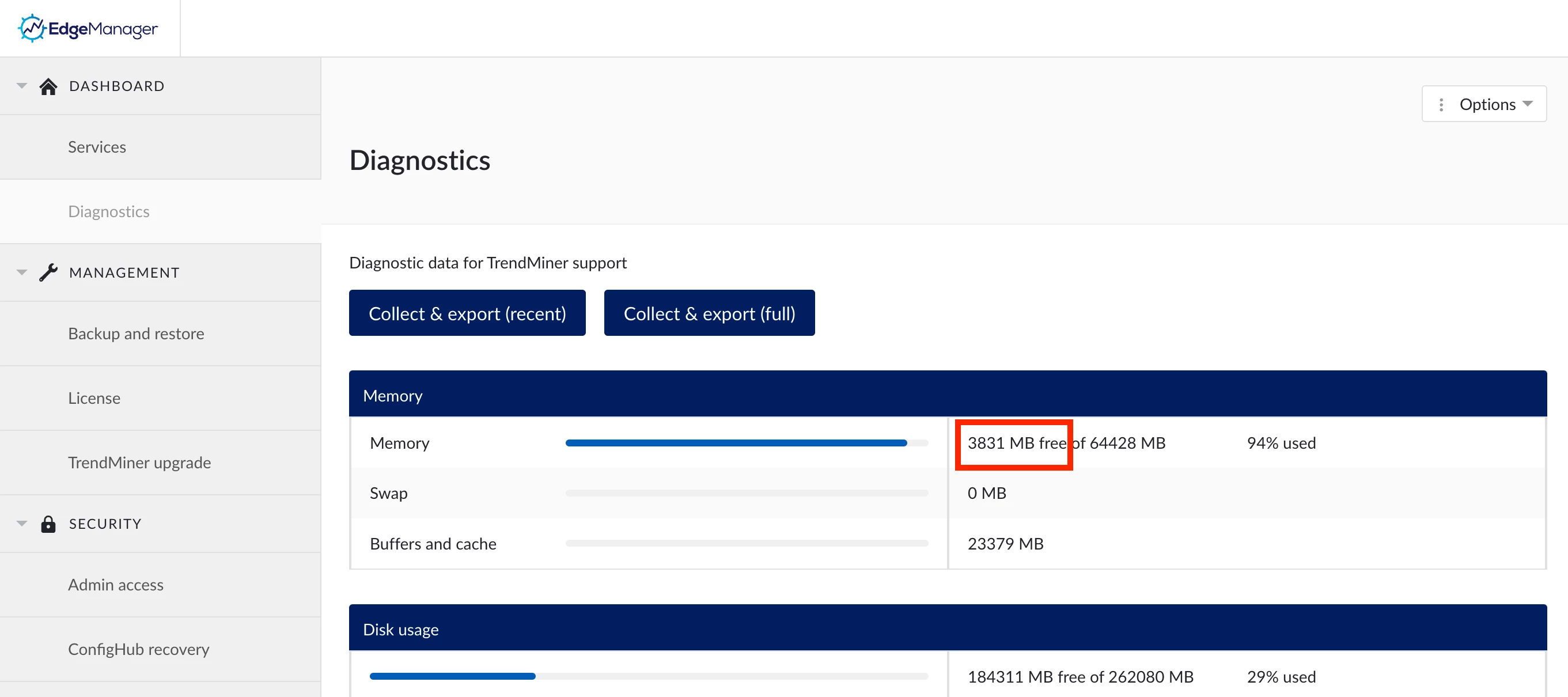
Sometimes we get contacted by admins who are concerned about the memory usage of their TrendMiner installation. In Edge Manager -> Diagnostics you can check the amount of memory (RAM) available for the TrendMiner server and the percentage of memory which is used. In most cases, when you check these numbers you'll notice that the usage is over 90%, often even close to 100%. Rest assured, this is not an issue. Linux (the OS on which TrendMiner runs) uses all available memory for optimal performance, instead of leaving it unused. If you are interested to read up on all the details we can advise to check this site: https://www.linuxatemyram.com (disclaimer: this is an external website, unaffiliated to TrendMiner and TrendMiner is not accountable for the site nor its content). So how does TrendMiner use its available memory?Each microservice in TrendMiner gets assigned a fixed amount of memory based on the needs of the service. Our engineers make sure everything fits within the minimal
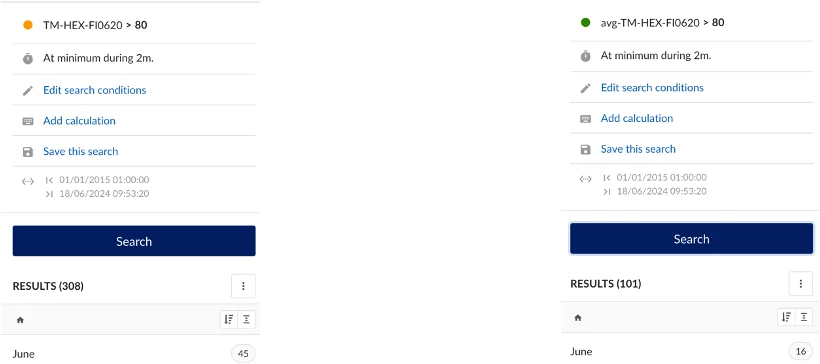
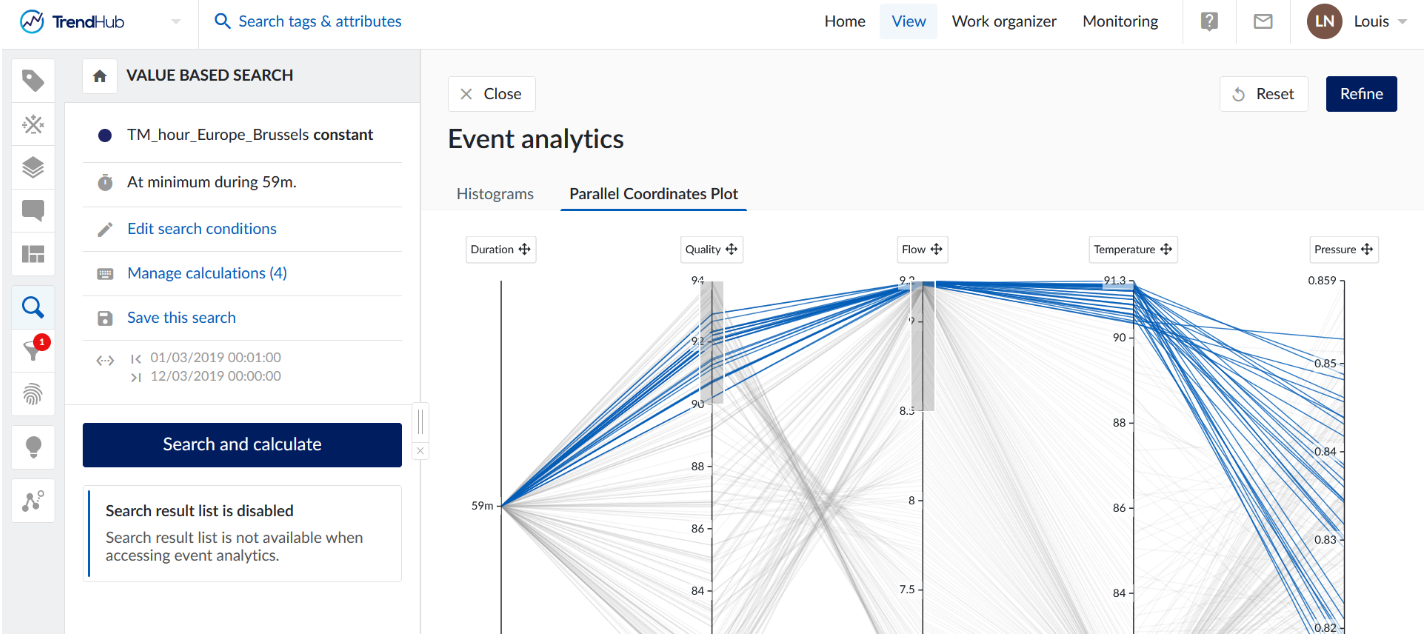
We all love the monitor feature in TrendMiner, however sometimes it can also be annoying when the monitor is triggered too many times and creates an email spam. In this article we will discuss how you can prevent an endless stream of TrendMiner monitor alert (emails) and just get an alert when a real event occurs.1. Use search results as indication for number of alertsA TrendMiner search is often the backbone of a monitor and thus we can use the number of search results as indication to the amount of monitor alerts we will get within the search period. For example, if we perform a search with a context bar period of 6 months and get 15 results, then we know that when we apply a monitor with this search we will get 15 monitor alerts within 6 months.2. Finetune your value based searchWhen you use a value based search the first thing you can tune to optimize your monitor is the minimal duration setting of your value base. In this example we want to know for when our flow out of our pump i
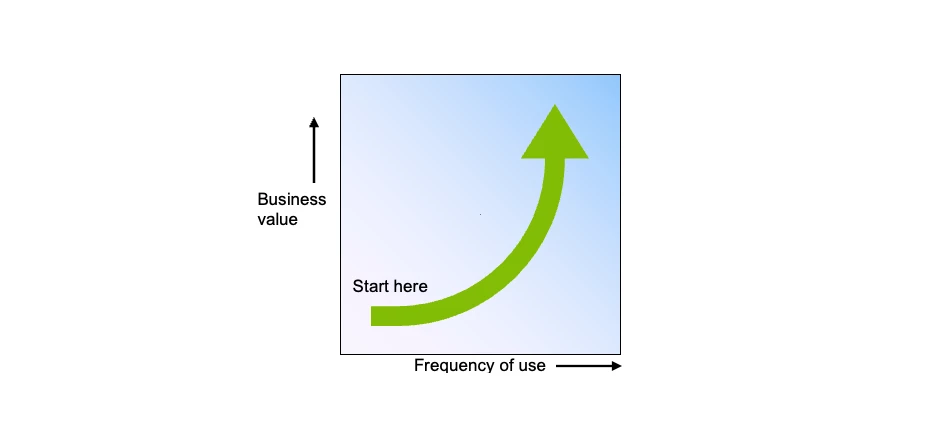
LyondellBasell rolled out TrendMiner globally after the initial success of the pilot with a dedicated project team and TrendMiner’s Customer Success team. Highlighted below are the key steps taken to achieve success. Identify the business needs for a solution Identify challenges and key users who are SMEs to drive the project Select pilot sites with the most potential to test & evaluate the solution Start with smaller but practical use cases to build confidence and gain trust of SMEs. Avoid the temptation to take on the most challenging tasks first to prove value. In the value matrix, start from the lower left-hand corner and work towards the upper right-hand corner Communicate and celebrate even the smallest wins Scale to more challenging use cases for higher valueValue Matrix With the successful pilot and proven business value, operationalize the pilot approach to other areas with a similar business need.Operationalize the pilot template for rollout Implement a project team con
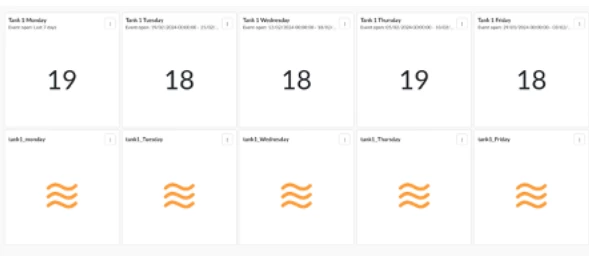
BackgroundThis use case shows how to create a dashboard that shows the number of events per day of the week. This can be emptying/filling of a tank or number of produced batches, or any event indicated by a tag in TrendMiner. Having such an overview can help you gain better insights in your process operations.SolutionThe solution includes the following steps:Value based search: Create a value based search to identify the events you want to count on your dashboard. Based on the search results create context items as stated in step 2. Also save the search to enable a monitor based on it for future context item creation. Context Item Creation: Each time an event happens, a context item is created to record the event via the search results or the monitor. This context item captures pertinent details such as the timestamp of the event and the day of the week as a keyword. Keyword Tagging: The day of the week is tagged as a keyword for every context item, facilitating easy categorization and
Red Hat Enterprise Linux 7 (RHEL 7) and the derived CentOS 7 are nearing their end of support. To ensure continued reliability and security for TrendMiner, we are transitioning TrendMiner to run on to the long-term supported Red Hat Enterprise Linux 9 (RHEL 9) and AlmaLinux OS 9 distributions. Infrastructure can already be prepared based on these new OS’s and the new system requirements. A new pre-packaged virtual appliance image based on AlmaLinux 9 has been made available for this purpose.Migration optionsThere are 2 options to migrate the existing server data to the new instance:Full migration including index data based on remote backup & restore (Azure Blob Storage or AWS S3 Bucket are the supported options) Work migration excluding index data based on local backup & restoreThe full migration is highly recommended as it will ensure the smoothest migration path with the least disturbances for end-users.Full details, with additional considerations, can be found in our documen
With dedicated individuals in each role, we maximize our chances of project success and organizational advancement. The successful implementation and continuous value from TrendMiner is tied to a strong project manager and change management practices guided by one of our Customer Success Managers (CSMs). To ensure success, CSMs partner with three key roles: Sponsor, Project Manager, and Team Lead(s). The Sponsor sets the project's direction, ensuring alignment with organizational goals and providing clear priorities tied to business initiatives. The Project Manager drives the project forward, navigating its planning and execution while adhering to time, cost, and scope constraints. The Team Lead(s) focus on the human aspect of change, facilitating engagement and adoption of our TrendMiner platform.
At the top of the page, click on the 'Events' button located to the right of the TrendMiner logo to view all our currently active events.Or you can click here to be redirected to the page.
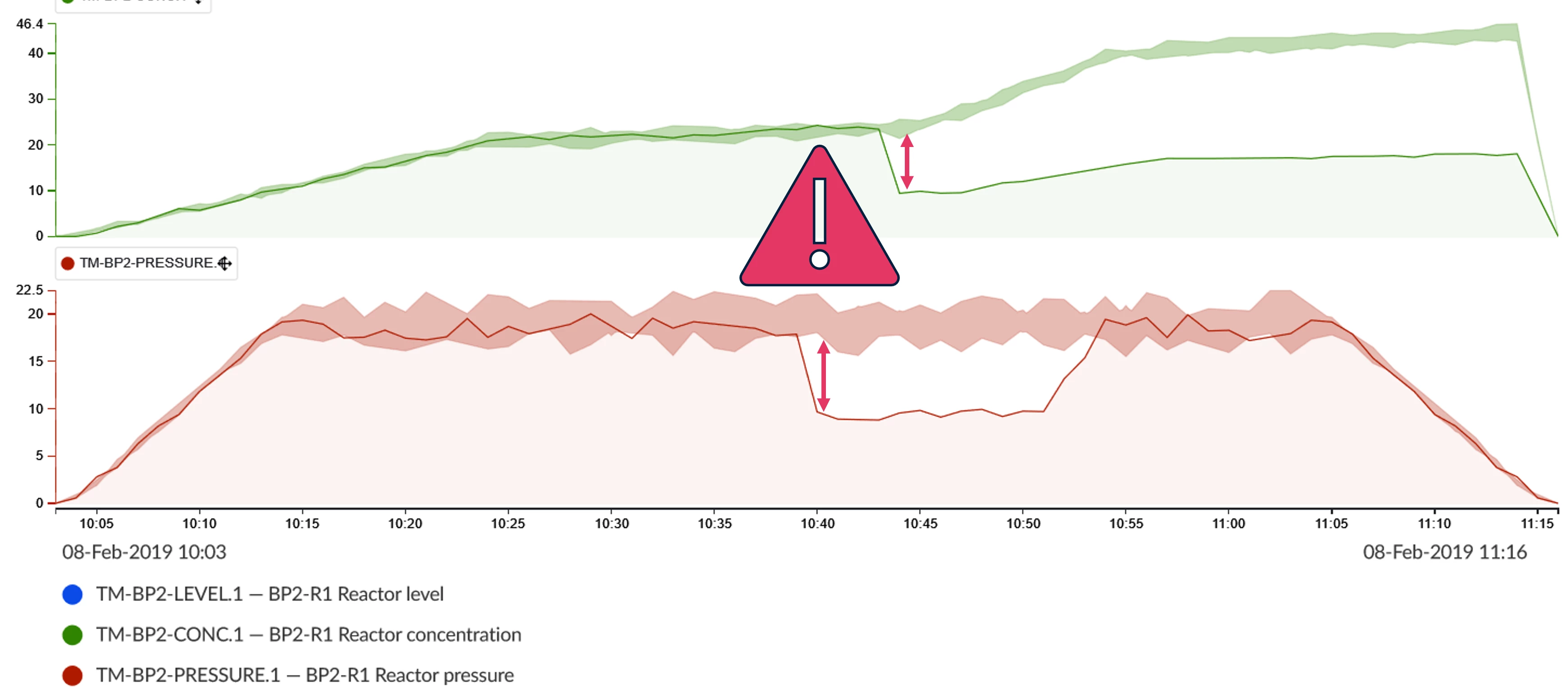
BackgroundIn our batch process, ensuring optimal operating conditions is critical for maintaining production, product quality and worker safety. Monitoring various process parameters such as low average temperature, constant pressure, high end- concentration and low energy consumption in real-time is essential to maintain consistency and quality across batches. ChallengeOur challenge was to implement a comprehensive system for monitoring operating conditions in a batch process with 7 regularly changing recipes. Over the past month, we have experienced problems with parameters deviating from optimal process conditions, resulting in poor product quality. We needed a solution that would accurately monitor the trend profiles at each step of the process and alert operators when these deviations occurred. The alert should provide actionable insight for operators and supervisors to optimize production processes and minimize product loss. Solution1. Visualizing the trendsA list of tags was add
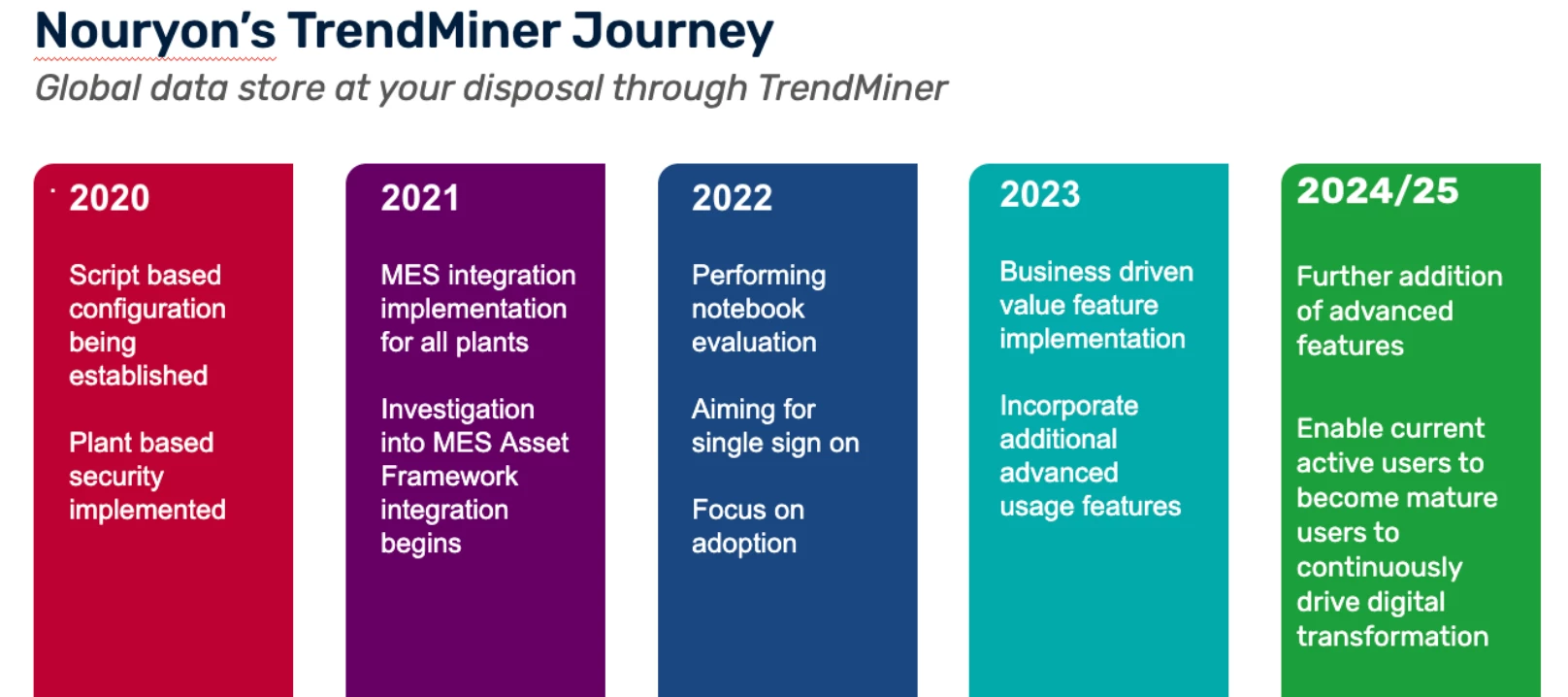
During TrendMiner’s 2023 annual user event, Si Hu highlighted the phased approach taken by Nouryon to implement TrendMiner. Here are some of the key items mentioned. Establish the vision of a global data source starting with a proof of concept. Establish the TrendMiner foundation through secure implementation at each plant for a global roll out. Systems integration with TrendMiner including Single-Sign-On (SSO). Drive business value through feature implementation and adoption. Continuous enablement of existing users to drive digital transformation.
BackgroundIn the chemical industry, calculating e.g. hourly consumption rates of critical resources such as energy, steam, electricity, and others is important. Accurate calculations enable efficient resource utilization and optimal process control. Continuous monitoring of these consumption rates allows for early detection of potential bottlenecks and facilitates proactive measures to enhance efficiency. ChallengeConsumption can be calculated both as rolling hourly averages and as fixed hourly values. Subsequently, the derived consumption values serve as the foundation for resource utilization monitoring, identifying efficiency potentials, and implementing targeted measures for process optimization. SolutionCalculating rolling hourly averagesThe rolling hourly average consumption is calculated using aggregation in the tag builder menu. We select our tag of interest, choose the average as the operator, set the direction to backward, and specify a one-hour aggregation window. With the
BackgroundThe final product dosing process relies on a tank with rotors, maintaining a constant level and rotors speed during production, but level drops significantly when changing products. This drop in tank weight slightly reduces dosage, potentially leading to customer complaints about low product weight.Operators manually increase rotor speed during tank emptying to compensate, but monitoring this action is crucial. ChallengeAutomatically keep track of the number of times and dates when emptying happens and whether or not the speed of the rotors was increased, for traceability purposes. Create a daily dashboard to be used during operating meetings Only emptying events of more than 15mins are relevant. SolutionCreate aggregations: Range of the rotors and Max of the tank level in the last 20m. Value Based Search for good and bad emptying periods of at least 15m: max level>60 & current level<50 + (rotors range>0/range=0). This search will find periods where the tank used
BackgroundSoft sensors, also known as inferentials, play a crucial role in industrial processes by predicting important lab values or other slow-sampled variables. In many manufacturing environments, the process involves monitoring various parameters that are critical for quality control or process optimization. However, some of these parameters, such as lab values, are slow to sample due to the time required for testing. This delay can hinder real-time decision-making and potentially lead to inefficiencies or quality issues. Soft sensors offer a solution to this challenge by using fast-sampled inputs as inputs to a machine learning model. This model can then predict the slow-sampled variables, providing real-time insights without the need to wait for hours for the next lab sample to be tested. Operators can monitor these predictions and make timely adjustments to the process, optimizing operations and ensuring quality standards are met. ChallengeOur primary challenge is to develop a
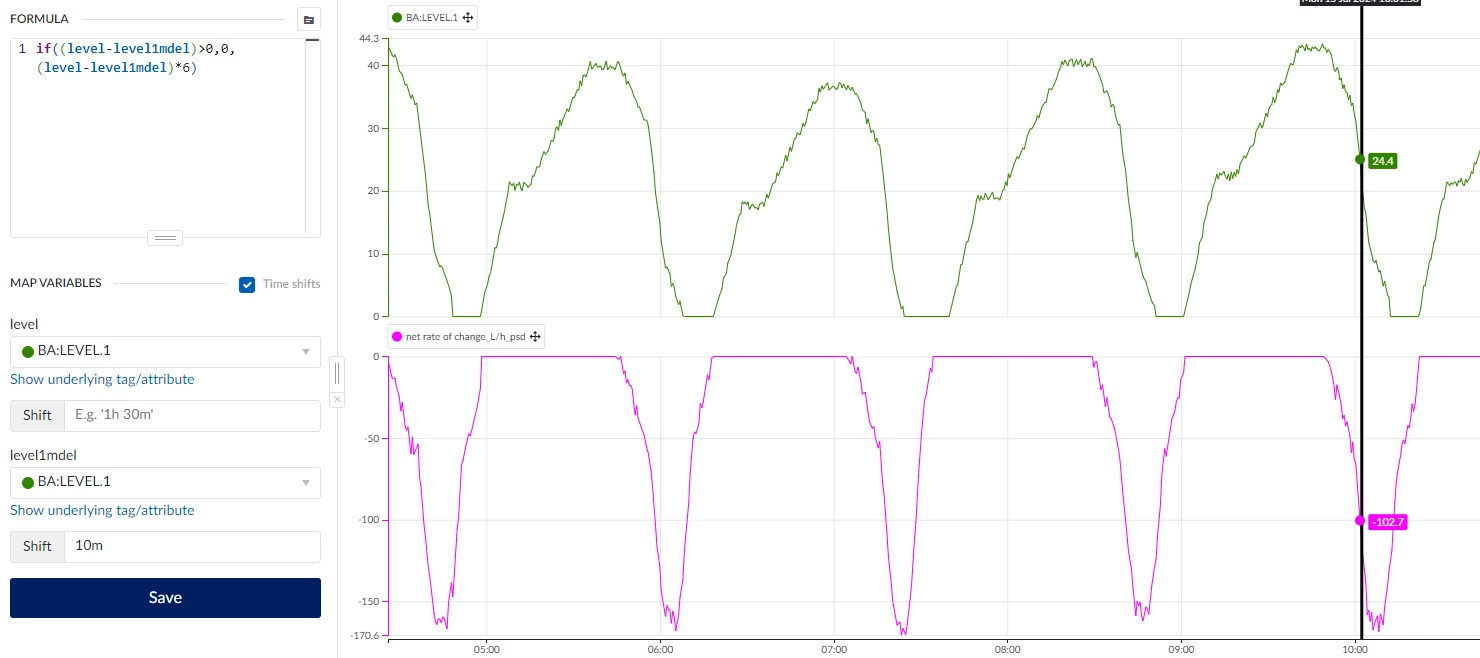
BackgroundThis use case shows how to report the daily specific consumption of a resource and make a comparison between them on a daily basis. At this point we have no way of comparing or keeping track of the specific consumption of a resource. If we would have a tag for this it would be a big help in terms of process and resources optimization, as well as bring economic value. The daily specific consumption will be reported as spikes at the end of each day. As a starting point we have a tag containing our specific consumption of the last 24h. By being able to have an overview of the spikes of all days we can optimize our process. Challenge1. Get a spike at the end of each day with the 24h of total consumption.2. Get the value of different days to compare them. SolutionCreating daily consumption spikesThe daily consumption spikes tag is created by using the formula tagbuilder, we use an if statement where the check is day1=day2 with day 1 current time tag (day) and day 2 1m delayed time
BackgroundIn any industry, It is not uncommon for plant managers to have questions about the status and efficiency of manufacturing units. There can be several hundred or even thousand tags for a single process depending on its complexity. Creating a dashboard allows users to centralize the trends for those tags in a digestible format. ChallengeOftentimes, production questions from management can be time-consuming and even intimidating to address. When a plant manager inquired about the status of a unit in the morning, a dashboard was created to ease their concerns within hours. SolutionIdentify relevant tags Consider what KPIs and parameters are important to management. Some examples are: flow rates for high-cost reactants extrusion rates (if applicable) expensive or shared utilities quality data production rates safety valve positions flaring All of these have financial, environmental, or safety implications.Create views and monitors Create TrendHub views and group r
In this series of posts, we will dive into the building blocks for a personal TrendMiner Coach Success plan. The topic of this second post is Desire. You can find our first post on Awareness here. Definition of DesireThe personal choice to support and engage in getting value form the TrendMiner platform. Planning desire creationDesire can be influenced, but in the end it is a personal choice of each individual to engage with the TrendMiner platform. At first, we want to motivate users to give TrendMiner a shot. We want to create the want to be personally engaged which will make them more resilient to become an advocate later in the process. Why?Personal and organizational motivating factors are needed to fully engage A personal engagement is needed for all subsequent stages of the ADKAR change management framework to have effect Desire creation: Your plan & best practicesAnticipate resistance Think about which points of resistance your target audience might have. An important point
On April 9th, 2024 we hosted an exclusive webinar to discuss relevant topics for TrendMiner admins related to the 2024.R1.0 and upcoming releases (recording below).The following topics were covered:What’s new in 2024.R1.0?A quick overview of functional updates and newly available connectivity options. In 2024.R1.0, we added connectivity for Eschbach Shiftconnector, Wonderware 2020 and 2023 and Aspen APRM v14. A complete overview of supported connectivity options is available here.Admin roles comparedTrendMiner 2024.R1.0 introduces a new admin layer to better separate Infrastructure, System and Application administration tasks. Refer to this topic for a complete overview.About the upgradeThe 2024.R1.0 release introduces some major security improvements in ConfigHub and the way you can access ConfigHub. Refer to this documentation article to learn how to access ConfigHub after the upgrade by resetting the admin user password via Edge Manager. It is advised to only use the admin user for
In this series of posts, we will dive into the building blocks for a personal TrendMiner Coach Success plan. The topic of this first post is awareness. Why do I need a Coach Success plan?A Coach success plan ensures you’re covering the rollout/adoption of TrendMiner with the best practices of change management in mind. The plan helps to avoid pitfalls and to optimize chances of peers achieving TrendMiner value. Definition of AwarenessAwareness is a person's understanding of the nature of the change, why the change is being made and the risk of not changing. Planning awareness creationBuilding awareness can be much more difficult than it sounds. For example, when you hear about a change, do you trust the sender of the message? Do you believe the reasons given for why the change is needed? Even in our everyday life, we encounter many ideas for change in which we do not agree with the messages we’re given. As a TrendMiner Coach, you need to understand the activities that drive awareness &
In this article, we present 4 of our least used but valuable features which you can use to your advantage. We also show some concrete examples. 1 - Operating Area Search Empowers users to intuitively identify optimal and suboptimal operating conditions through a visual interface. Helps users detect process irregularities early by analyzing correlations between parameters. Provides preventive maintenance warnings using the operating area search in a combination with monitors. In the example shown below, the power a conveyor belt is consuming is plotted versus the specific power consumption, which takes into account the mass the conveyor belt is transporting. The scatter plot itself shows that there is an optimal point of operation looking only at energy consumption. Now, this area is selected as area of good operation and is used in the operating area search to look for periods when this correlation is changing, indicating a change in the operating conditions of the belt which me
Implementing new software or technologies requires an investment of time, effort and resources. A well-designed adoption plan ensures that your organization fully utilizes these tools, maximizing the return on investment (ROI). This is no different for a platform like TrendMiner. Below, some hints are shared on what to consider when making such a plan: Begin by understanding your organization’s specific needs, challenges, objectives, and long-term goals What problem does the software solve? How will it align with your business objectives? For example: too many batches are being rejected and the goal is to reduce this amount by 40% by detecting quality deviations. Engage key stakeholders from different departments (such as IT, operations, and end-users) in the planning process Their insights and perspectives are invaluable for creating a comprehensive adoption strategy. For example, when new connections are configured or new functionality is released and timely TrendMiner upgrades are
BackgroundThis use case is centered on a mixing tank, where the streams of two distinct products are joined. The intermediate products are continuously added to the mixing tank until it reaches a certain level. At that point, a sample is taken for analysis, and the tank is emptied into a larger storage tank. ChallengeOver the span of a few weeks, there have been crystallization issues with one of the two products. This undesired crystallization interferes with sensors leading to unreliable measurements, which can lead to quality issues as the mixture is processed further.We needed to find the root cause of these crystallization issues. SolutionVisualizing the problem The composition of the samples from the mixing tank was displayed in TrendMiner. Here we could clearly see the concentration of the solvent product decreasing, which is an obvious cause of the other product crystallizing. The question thus becomes: why are we receiving less solvent from our production process? Hypothesis
Since TrendMiner version 2023.R3.0 configuration settings have been split up between Edge Manager and ConfigHub. This way, tasks specific to infrastructure admins and system admins are clearly separated and access permissions can be aligned with your organizational structure.Edge Manager is the TrendMiner interface for infrastructure admins. It mainly contains functionality to keep your TrendMiner installation healthy and up-to-date. Edge Manager is not available to SaaS customers as infrastructure administration is taken care of by the TrendMiner team. On virtual appliances, some additional menus for virtual appliance configuration will be available, which do not appear on self-managed single node or private cloud setups. The following tasks can be done from Edge Manager:Checking the health status of TrendMiner services Downloading appliance logs for troubleshooting purposes Gaining insights into memory usage, disk usage (including adding more disk space), CPU usage and time settings
The TrendMiner setup knows 3 different administrator roles:Infrastructure administrator (taken care of by TrendMiner for SaaS setups) System administrator Application administratorThe table below provides an overview of these roles, required skills and access permissions, example tasks and where to perform these tasks in the TrendMiner User Interface.Obviously, one person can take up multiple admin roles, but as different types of tasks are typically distributed over multiple people or teams, these roles permit to match TrendMiner administration to your organizational structure. Infrastructure administrator System administrator Application administrator TrendMiner UI Edge Manager ConfigHub TrendHub, ContextHub, TrendMiner API Description The infrastructure admin is responsible for installation and maintenance of the TrendMiner servers on infrastructure, network and security l
How do you streamline communications around TrendMiner in a large organization? At TrendLab 2021, Nina Mas Soler and Laurent Baseilhac discussed how they use a community strategy to make sure end-users can find and share all information they needed.Some pointers:Survey your end-users to discover how they use the platform and the value this brings Create an internal community website, containing for example: self-paced training videos invitations to online trainings for new users a live chat to internal TrendMiner experts a tool to identify interesting use cases from across the whole organization easy to find contact details of key users in all plants Watch the full presentation here and discover Arkema's priorities for digital manufacturing, what their community strategy entails and what their end-users are saying about TrendMiner.How do you streamline communications in your company? What resources have you created to enable TrendMiner users to generate more value for your compan
Already have an account? Login
No account yet? Create an account
Enter your E-mail address. We'll send you an e-mail with instructions to reset your password.